
You have finished lunch in Kolkata.
Outside, the city is still going about its afternoon—traffic, shops, crossings, people rushing somewhere.
Your luggage goes into the vehicle and the journey begins.
For the next few hours, there is no dramatic transformation. Kolkata gradually loosens its grip. Buildings become less continuous. Roads become narrower. Villages appear more frequently. Ponds, fields and stretches of open Bengal begin replacing the city.
And somewhere during that drive, without quite noticing when it happened, you begin to feel that you are going somewhere different.
That gradual transition is deliberate.
We start our Whispering Winds journeys after lunch because we believe a Sundarban experience is not only about where you go. It is also about when you arrive there.
It starts with something very ordinary: lunch
A road journey from Kolkata towards the Sundarban waterways normally takes several hours. The actual time naturally varies with traffic, pickup location and road conditions.
That is long enough to feel tiring. But not long enough, in our view, to make lunch another scheduled event in the middle of the transfer.
So we prefer a much simpler beginning:
Have lunch comfortably in Kolkata. Then start.
There is no need to begin the holiday hungry, search for an appropriate lunch stop halfway, wait for food, and then get back into the vehicle for the remaining drive.
The road journey is still a road journey. We do not try to pretend that sitting in a vehicle for several hours is the highlight of a Sundarban holiday.
Instead, we try to place it where it causes the least disruption to the experience that follows.
Lunch is finished. The luggage is packed. There is nothing more you need to accomplish that afternoon.
You can simply travel.
The road ends. The experience begins.
The Sundarbans is different from destinations where the vehicle takes you all the way to your hotel.
Eventually, the road has done its job. Ahead lies water.
Access to the Sundarbans typically combines road or rail travel with onward movement by boat. Depending on the journey and operating arrangement, different river gateways may be used.
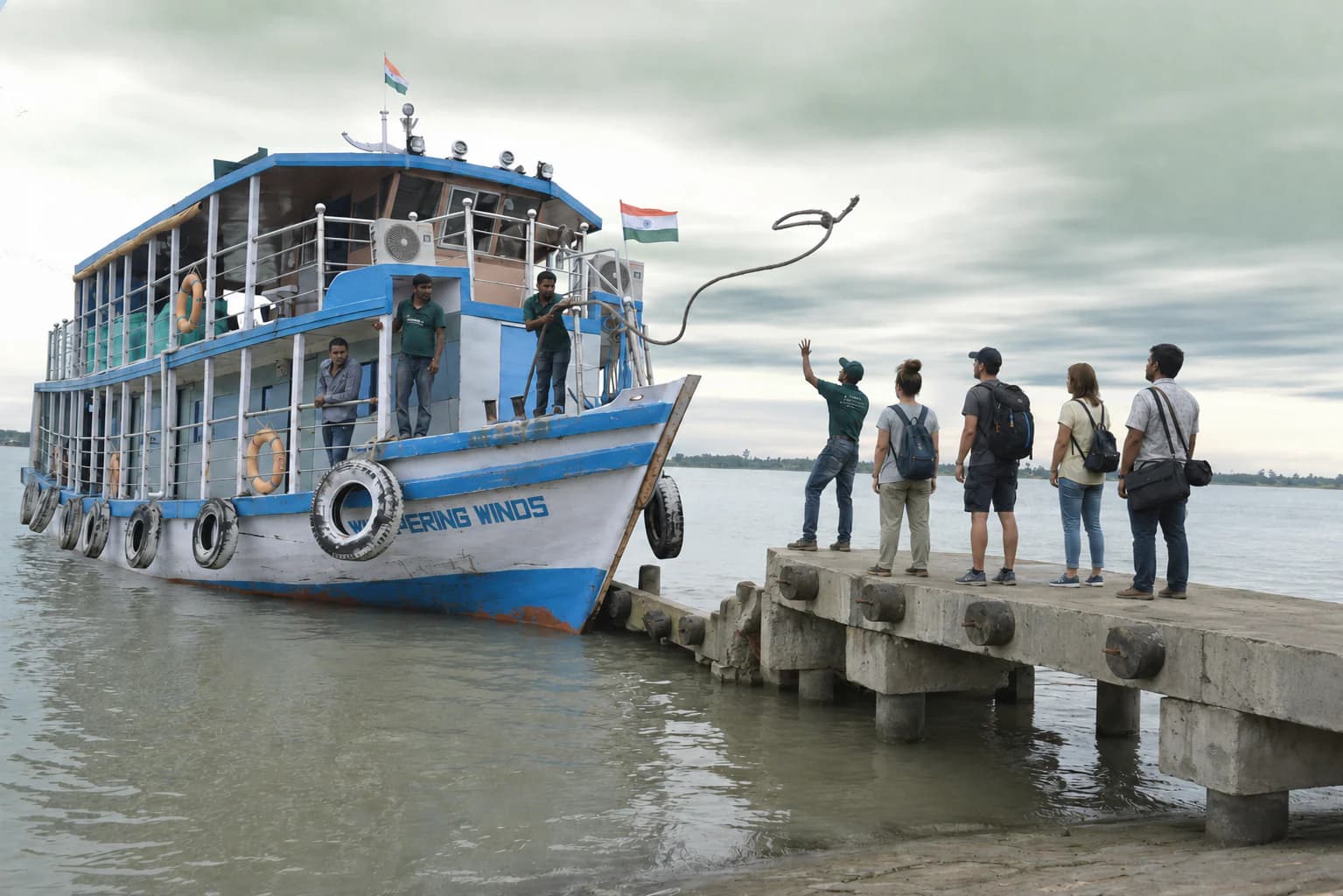
For a Whispering Winds journey using Godkhali, we normally aim to reach the houseboat jetty in the late afternoon, around the time when the character of the day is beginning to change.
This timing matters.
Because we do not want your first memory of the houseboat to be simply: We reached. We boarded. We went to sleep.
We want the river to have time to introduce itself.
Why late afternoon?
Imagine reaching the jetty in the late afternoon.
The road journey is behind you. Your bags move aboard. There is a moment of settling in—finding your cabin, stepping onto the upper deck, looking around.
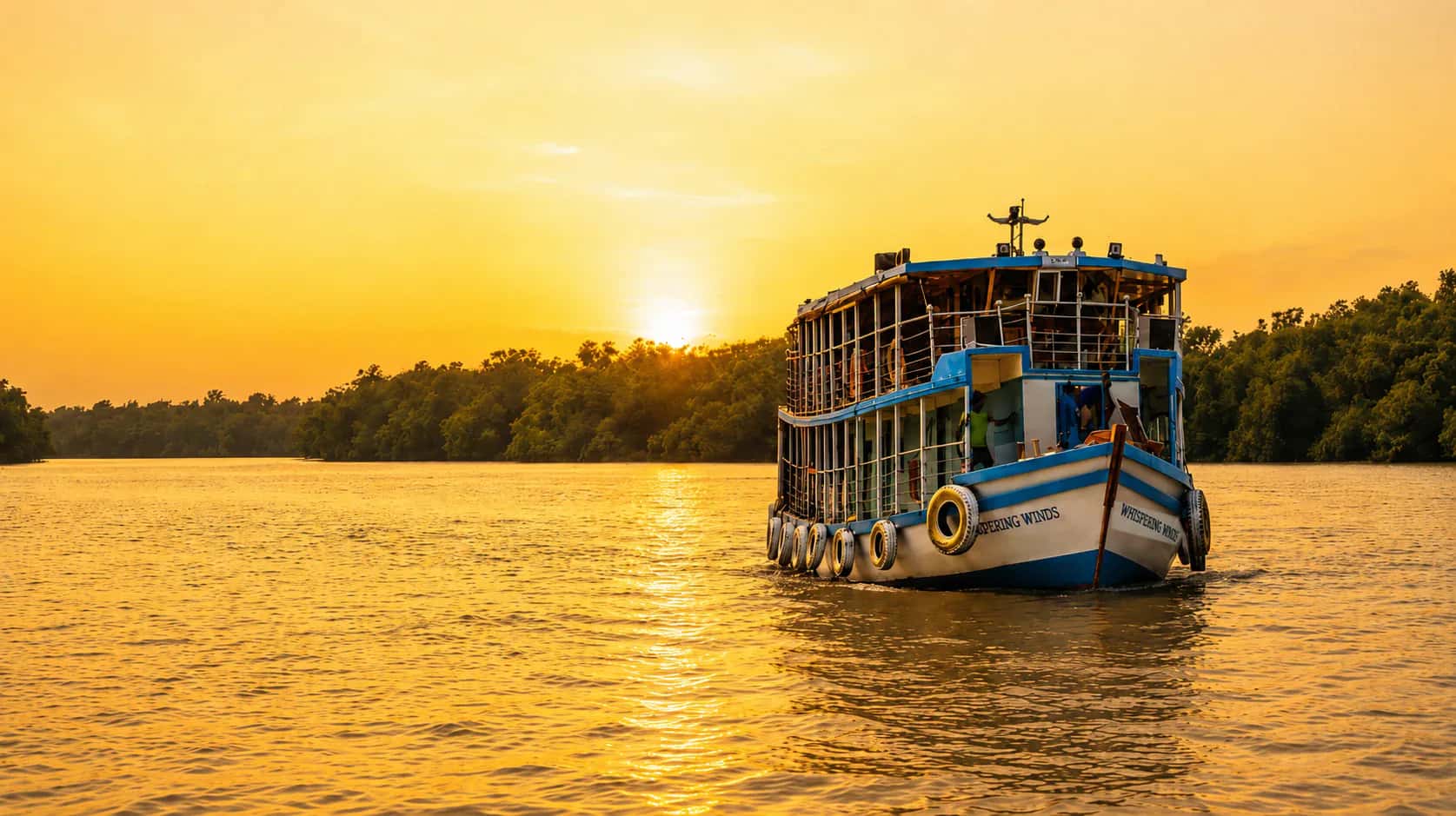
Then Whispering Winds begins to move.
The sun may still be visible. On another day, it may be partly hidden by cloud. Sunset itself varies significantly through the seasons, so no responsible itinerary should promise that one fixed clock time will always be sunset.
What we are trying to reach is something more reliable: the transition from afternoon into evening.
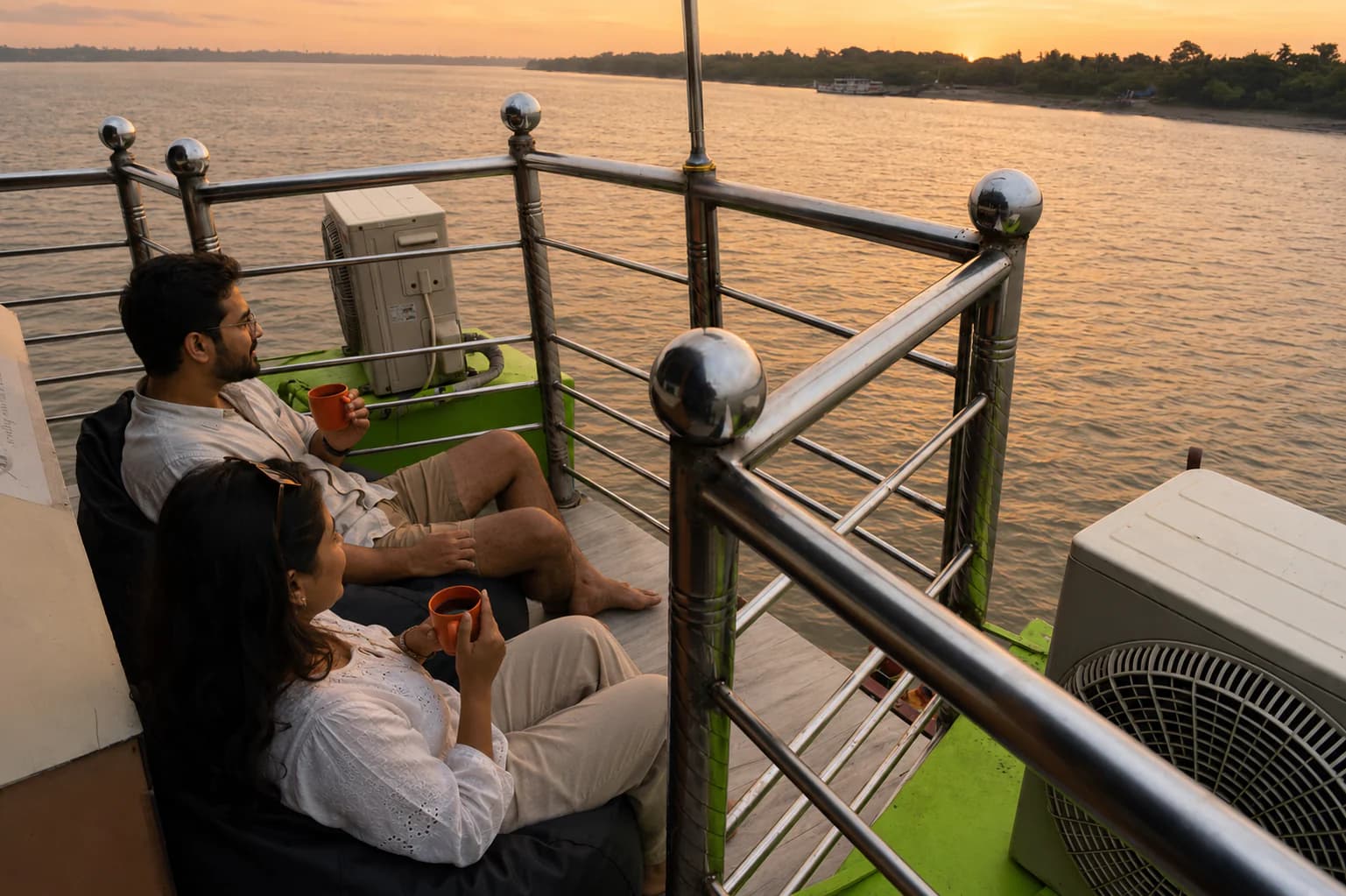
The hard daylight begins to soften. Colours change. Reflections on the water change. The air often feels different once you are away from the road.
And the city from which you started only a few hours earlier suddenly feels much farther away than the distance on a map would suggest.
This is the first reason timing matters.
The Sundarbans does not need a dramatic entrance. It needs enough time to reveal itself.
And then something unusual happens: it gets dark
Tourism usually treats darkness as an inconvenience. Sightseeing stops. Photographs become difficult. Views disappear.
We see it differently. On an overnight houseboat, darkness is part of the experience.
As daylight fades, your eyes can tell you less about what surrounds you. And that changes how you experience the place.
You notice the movement of the boat. The breeze across the deck. Water against the hull. A light somewhere in the distance. A sound whose source you cannot immediately identify.
The mangroves have not disappeared simply because you can no longer see every detail. You know they are there.
And that creates something daylight cannot create quite as easily:
curiosity.
During the day, the landscape explains itself visually. At night, it leaves questions unanswered.
Night creates curiosity. First light answers it.
Dinner tastes different when there is nowhere else to go
By now you are not rushing towards another sightseeing point. There is no restaurant reservation to reach. No vehicle waiting to take you back to a hotel.
The houseboat is moving through—or settling within—the river landscape, depending on the night's operating plan.
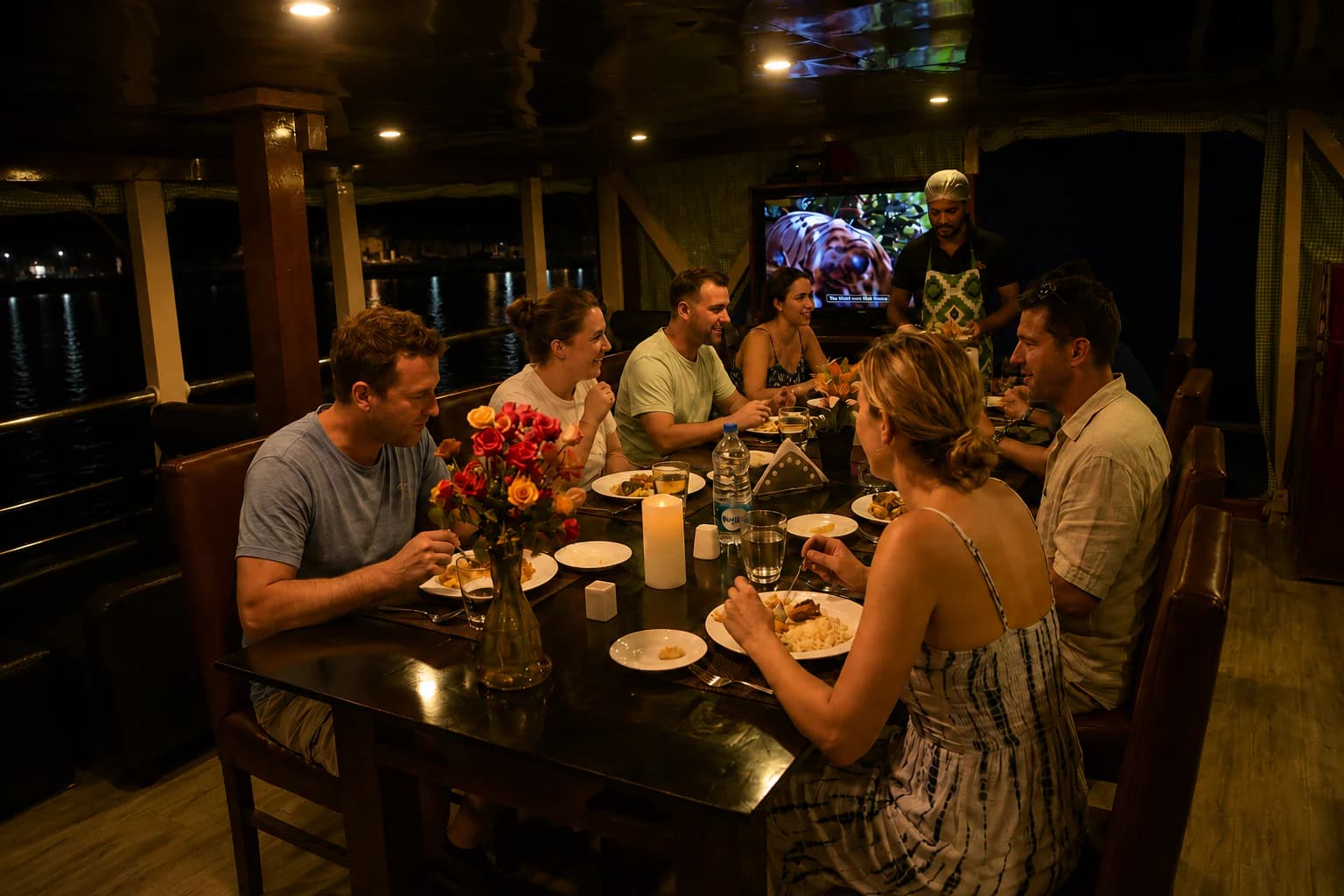
Fresh food is prepared onboard. You eat. You talk. Perhaps you sit upstairs for some time afterwards.
Perhaps you discover that doing very little can itself become one of the better parts of the evening.
This is why food matters to us beyond simply writing Breakfast, Lunch, Dinner Included in a package description.
Hot food arriving at the right moment keeps the experience continuous.
There is no interruption in which the Sundarbans suddenly stops while everyone goes somewhere else to eat. You remain aboard.
Then comes the part a day visitor cannot experience
Eventually you enter your cabin.
Outside the window is not a hotel lawn. Not a car park. Not another building. There is water. And beyond it, the darkness of the Sundarban landscape.
Whispering Winds has three air-conditioned guest cabins with attached bathrooms, but the real difference is not simply the cabin specification.
It is where you are when you close the door at night.
You have spent the evening getting closer to the landscape. Now you are going to sleep within that river environment.
And you know that when you wake up, you will not have to drive to the Sundarbans. You are already there.
That thought changes the morning before morning has even arrived.

There is some science behind why light and darkness feel so fundamental
Humans live according to approximately 24-hour biological rhythms known as circadian rhythms (opens in a new tab).
Light and darkness are among the strongest environmental signals influencing these rhythms. Light received through the eyes helps the body's biological clock remain aligned with day and night.
But we should be precise about what this means.
We are not claiming that leaving Kolkata after lunch resets your body clock.
We are not claiming medical benefits from a houseboat journey.
The idea is much simpler.
Our itinerary follows a sequence humans intuitively understand: afternoon → fading light → darkness → sleep → first light → morning activity.
Instead of fighting the natural rhythm of the day, the experience is built around it.
An experience designed around light, comfort and the natural rhythm of the day.
Not a ‘scientifically engineered holiday’.
Then morning begins
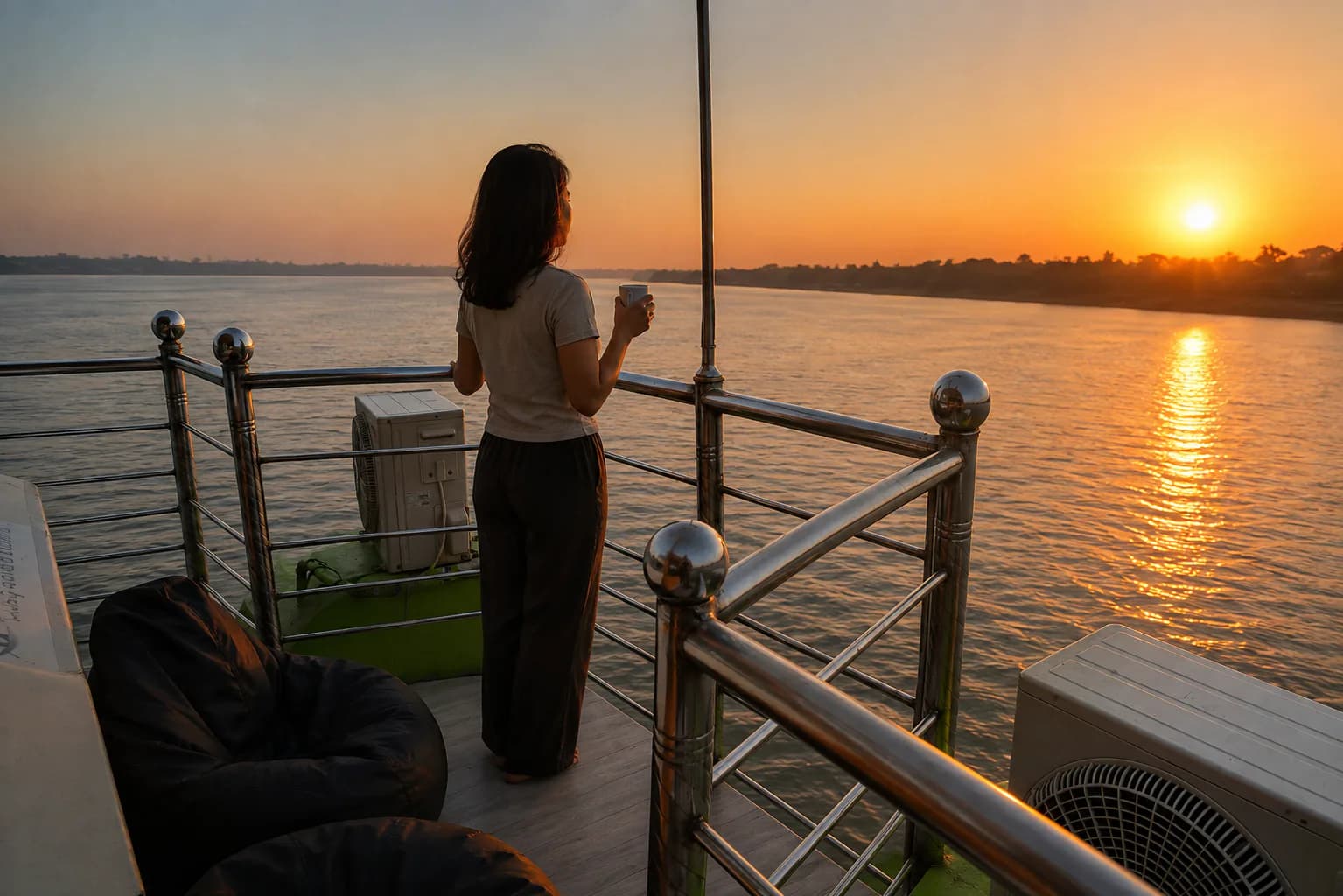
Morning in the Sundarbans does not need an alarmingly dramatic sunrise to be beautiful.
Some mornings may be golden. Others may be pale. There may be mist. There may be cloud.
But there is a particular pleasure in waking up and remembering: you are still on the water.
Step outside. The world that became mysterious after dark is visible again.
First the sky changes. Then the water. Then the mangroves begin recovering their colour and detail.
Bird activity becomes more noticeable. Boats and distant river life begin moving. The landscape appears to wake up around you.
And because you spent the previous night wondering what lay outside the darkness, morning feels less like another sightseeing session and more like an introduction that has finally been completed.
First light is when the Sundarbans introduces itself properly.
Now you are ready for the creeks
This is when the journey changes again.
The broad waterways give way to narrower channels and creeks as the planned forest exploration develops. Mangroves can appear on both sides. The scale changes.
You are no longer simply looking at an enormous river landscape from a distance. You begin moving through it.
Depending on the permitted route and operating conditions, the journey may include watchtowers and forest locations.
But this is also where expectations matter.
A spotted deer may appear. A kingfisher may flash across the water. You may see crocodiles, monitor lizards or other wildlife.
And somewhere within this extraordinary ecosystem lives the Royal Bengal Tiger.
You may see one. You probably will not know until the moment arrives. No itinerary can schedule it.
The tiger is a possibility.
The Sundarbans is the experience.


Why not do all this immediately after reaching?
Because we think there is value in meeting a place before trying to consume it.
Imagine the alternative.
Three hours in a vehicle. Arrive. Immediately begin intensive sightseeing. Watchtower. Creek. Another point. Photos. Checklist. Dinner. Sleep.
There is nothing inherently wrong with travelling that way. But Whispering Winds was designed around a different idea.
We want the first few hours to be less demanding.
Reach.
Board.
Settle in.
Watch afternoon become evening.
Eat.
Sleep afloat.
Wake up.
Then explore.
By the time you enter the narrower creeks the next morning, the Sundarbans is no longer somewhere you have just arrived. You have already spent a night with it.
Fresh food also follows the rhythm of the journey
There is another practical advantage to staying aboard. The kitchen travels with you.
Instead of structuring the route around where a restaurant happens to be available, meals can remain connected to the journey.
Hot breakfast in the morning. Food prepared while you continue travelling. Tea when the moment feels right.
This sounds like a small detail. But travel experiences are often improved—or interrupted—by small details.
When food comes to you rather than forcing the entire journey to stop for food, the rhythm remains intact.
Eventually, it is time to leave
This is the part of almost every holiday that nobody advertises. You have to go home.
The houseboat reaches the point where the river journey ends. Luggage comes off. You step back onto land. The vehicle is waiting.
And the road that felt like an introduction on the way in now has a completely different purpose. The onward journey contained anticipation. The return journey contains memories.
Depending on the season, traffic and operating schedule, some or much of the road back towards Kolkata may happen after daylight begins fading.
We do not consider that wasted sightseeing time. By now, the experience that required daylight has happened.
The photographs are already on your phone. The morning is behind you. The creeks are behind you.
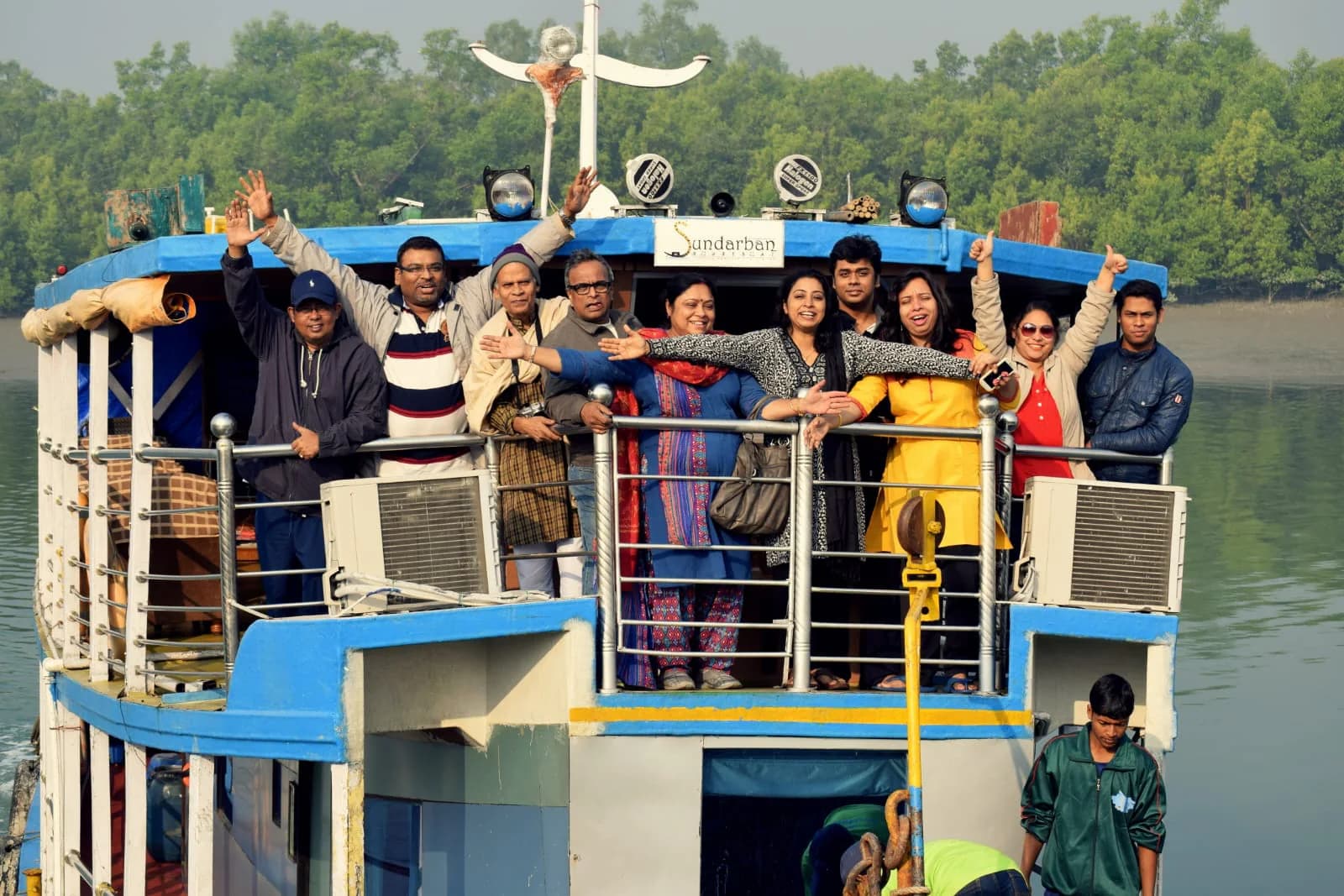
Perhaps somebody begins scrolling through photographs. Someone else talks about the bird they saw. Or the food. Or the strange sound during the night. Or simply what it felt like opening the cabin door in the morning.
And perhaps for part of the drive, nobody says very much at all.
The outward journey builds anticipation. The river creates the experience. The return gives you time to remember it.
So why do we start after lunch?
Not because an afternoon departure is automatically better for every Sundarban itinerary.
And not because there is one scientifically perfect hour at which everyone should leave Kolkata.
We do it because, for the Whispering Winds experience we are trying to create, the sequence works.
You can eat properly before travelling. The road transfer occupies the afternoon rather than the best part of your morning. You reach the waterways as the character of daylight begins changing.
Evening becomes part of the cruise. Darkness creates curiosity. Dinner remains onboard. You sleep close to the water. Morning becomes your first complete visual introduction to the Sundarbans.
Then come the creeks, mangroves, watchtowers and wildlife possibilities. Fresh food travels with the journey.
And the long road back happens after the experiences you came for are already safely stored in your memory.
It all comes down to one idea:
Being in the right place at the right time.
A normal itinerary asks: Where should we take the guest?
We prefer to ask another question as well: When should the guest be there?
Because sunset is not the same experience at noon. A night on a houseboat cannot be recreated during a day cruise. And sunrise means something different when you wake up to it instead of driving somewhere to see it.
Planning the complete road-and-river journey? See what a Sundarban package from Kolkata should actually include before comparing quotations.
A thoughtfully designed journey asks when you should be there.
A good itinerary tells you where to go.
That is why our Sundarban Houseboat journey does not begin with an early-morning race out of Kolkata.
It begins after lunch. Slowly.
The city falls behind. The road eventually ends. The river takes over. Daylight begins to fade.
And by the time morning arrives, you are not on your way to the Sundarbans.
You wake up in it.
Practical questions about the journey.
Why don't you start early in the morning from Kolkata?
Our journey is deliberately structured around an afternoon road transfer followed by the transition into evening aboard Whispering Winds. It also allows guests to have lunch comfortably before beginning the several-hour road journey.
Do we definitely see sunset while cruising?
We aim to begin the houseboat experience in the late afternoon and continue into evening. Exact sunset time and visibility vary with season and weather, so a visible sunset cannot responsibly be guaranteed.
Is the afternoon departure scientifically better for the body?
We would not make that claim. Circadian rhythms are influenced strongly by natural light and darkness, but there is no basis for saying that our departure time itself provides a medical or sleep benefit. Our itinerary simply follows the natural sequence of afternoon, evening, night and morning rather than trying to compress every experience into daylight.
How long is Kolkata to the Sundarban boarding area?
The road journey usually takes several hours. Actual time varies with Kolkata pickup point, traffic, route and current road conditions. The confirmed pickup and boarding plan is shared for each journey.
Is Godkhali the only gateway to the Sundarbans?
No. Different river gateways can be used depending on the tour arrangement, permitted route and operating requirements. The confirmed boarding point is shared as part of the journey plan.
The factual references behind this guide.
- National Institute of General Medical Sciences — Circadian Rhythms (opens in a new tab)
Official scientific overview of circadian rhythms and the influence of light and darkness.
- Sundarban Tiger Reserve (opens in a new tab)
Official information about the protected landscape, biodiversity, tourism access and operating rules.
- West Bengal Tourism (opens in a new tab)
Official state tourism information for travel context and destination planning.